Features
What the desk does, screen by screen. Every figure on these screens is computed in code and tested; a model may explain a number but never produce one.
A desk that argues
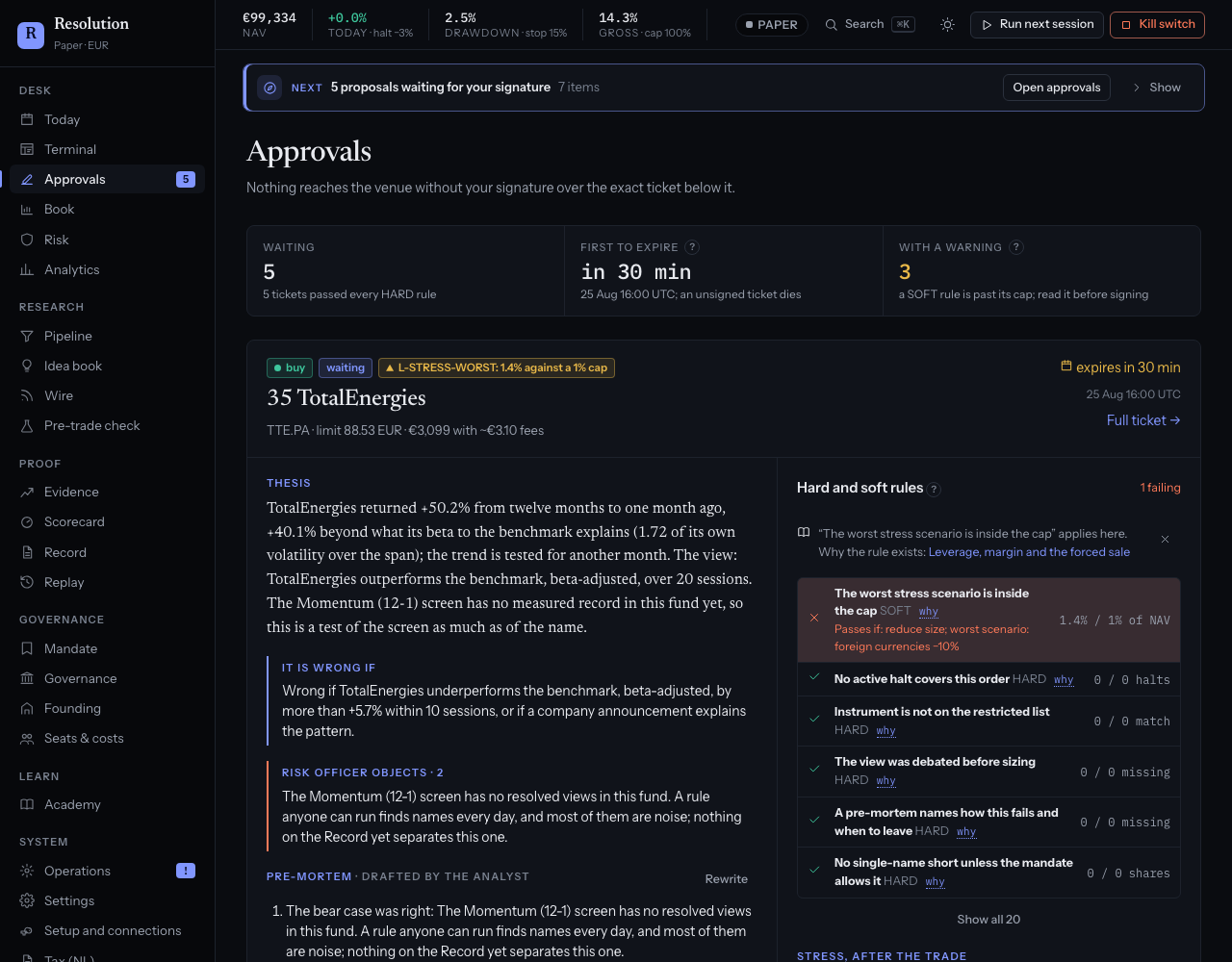
- An analyst drafts a view; two bears argue against it, in both orders; a judge scores the argument; a PM sizes it; a risk officer objects in writing.
- Every view carries a probability bucket, a horizon and a falsifier such as
price < 90. When the falsifier fires, the exit goes the normal way: the PM proposes it, the kernel checks it, you sign it. - Bring your own idea from Pipeline: it is researched at once while the cooling-off (
L-PROC-COOLING) holds commitment back until the next session close, unless you sign an override with a reason. - The judge must sit on a different model vendor from the bears. Outside text (pages, news, documents) travels in a bounded untrusted block and is data, never instructions.
- 52 model providers, with a provider and model per seat. Without a key, the seats run scripted at zero cost.
Rules that bind you, graded by you
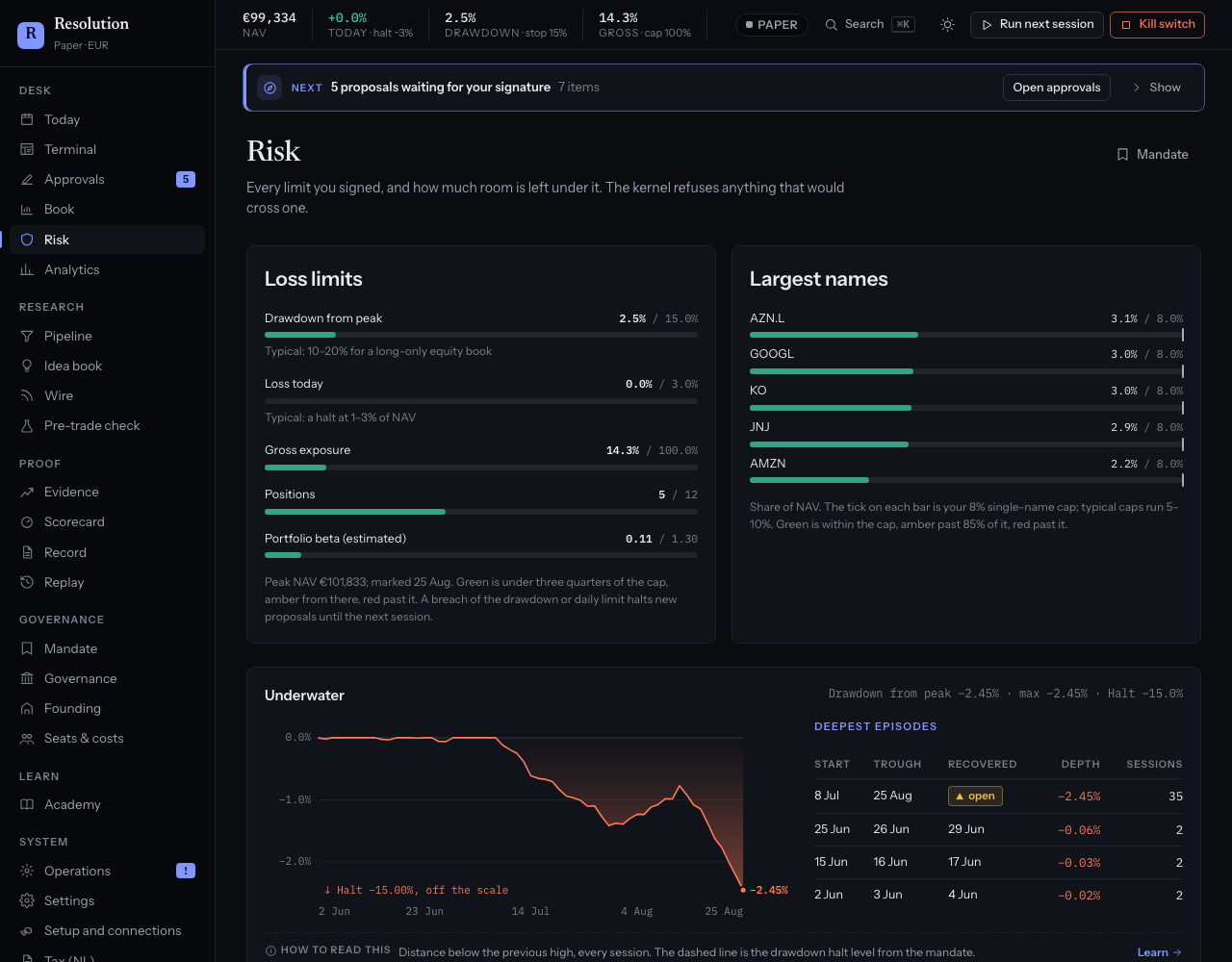
- 26 kernel rules across operations, process, concentration, loss, exposure, liquidity, cost and live trading. Each is HARD (blocks until a written override), SOFT (warns once with the measured number) or LOG, as you graded it at the founding. Floor rules are always HARD.
- Rules return a number against a cap, never a verdict: "1.4% against a 1% cap".
- A written pre-mortem before a proposal that adds risk can be signed. A checklist of your own past failures, built from your overrides, at signature. "Why this rule exists" one click from the ticket.
- Tightening applies now; loosening a cap or a grade waits out the cooling period.
- Reverse stress tests per drawdown tier, a cost-blind review mode, and an audit of the product against ESMA's list of engagement practices.
Measurement that can say "no edge"
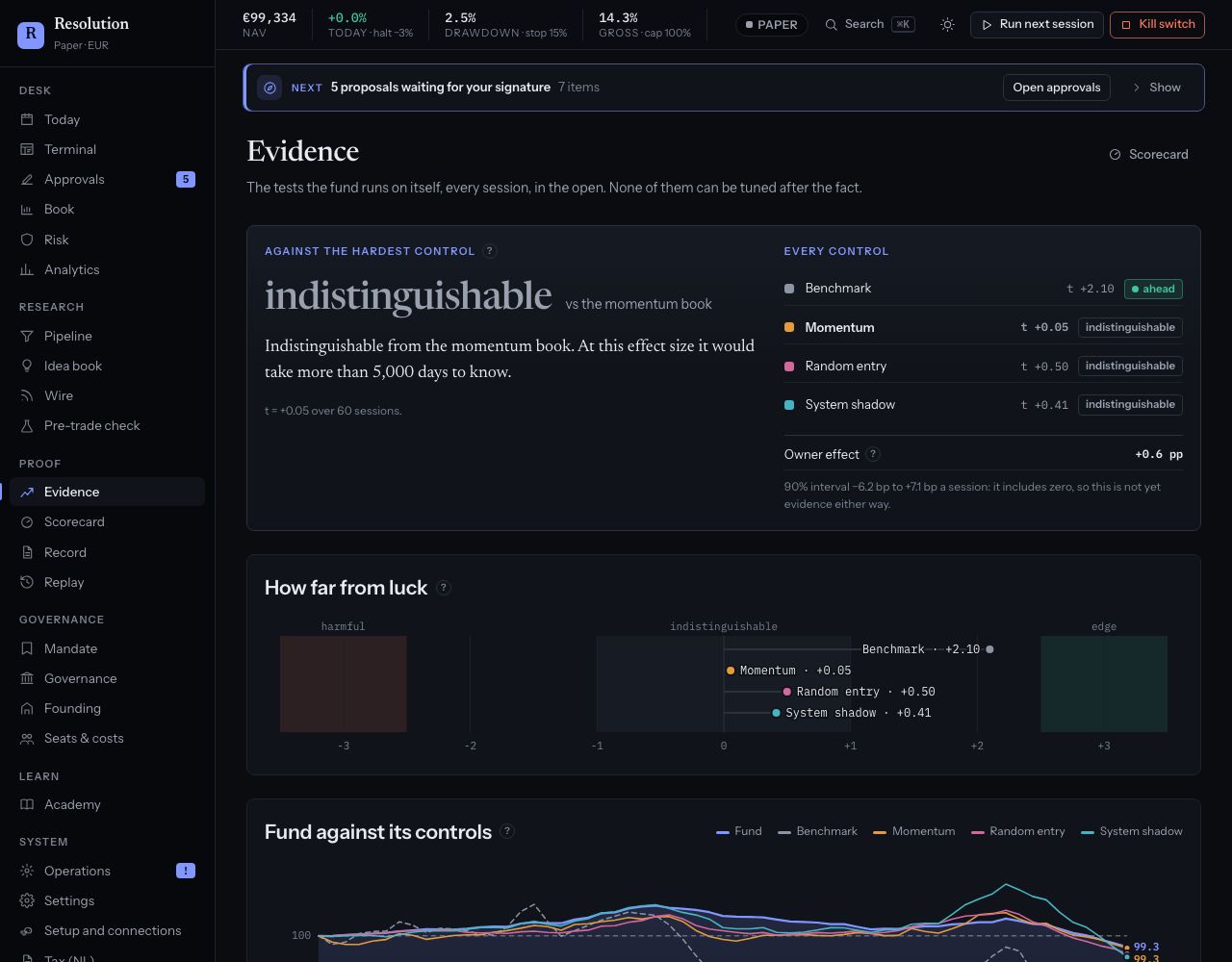
- Null books that trade at random, hold the benchmark or follow momentum, and the fund's gap to each with its t-statistic.
- Pre-registered hypotheses with alpha spending; a trial ledger with a t-bar of max(3.0, Bonferroni) and the Deflated Sharpe Ratio.
- Training-cutoff contamination flags: a seat is scored only after its cutoff. A judge position-swap check.
- Brier and log scores per seat, CRPS, calibration, and weekly per-screen rank IC at 1, 5 and 20 sessions. A Hansen SPA test against each null book.
Portfolio analytics
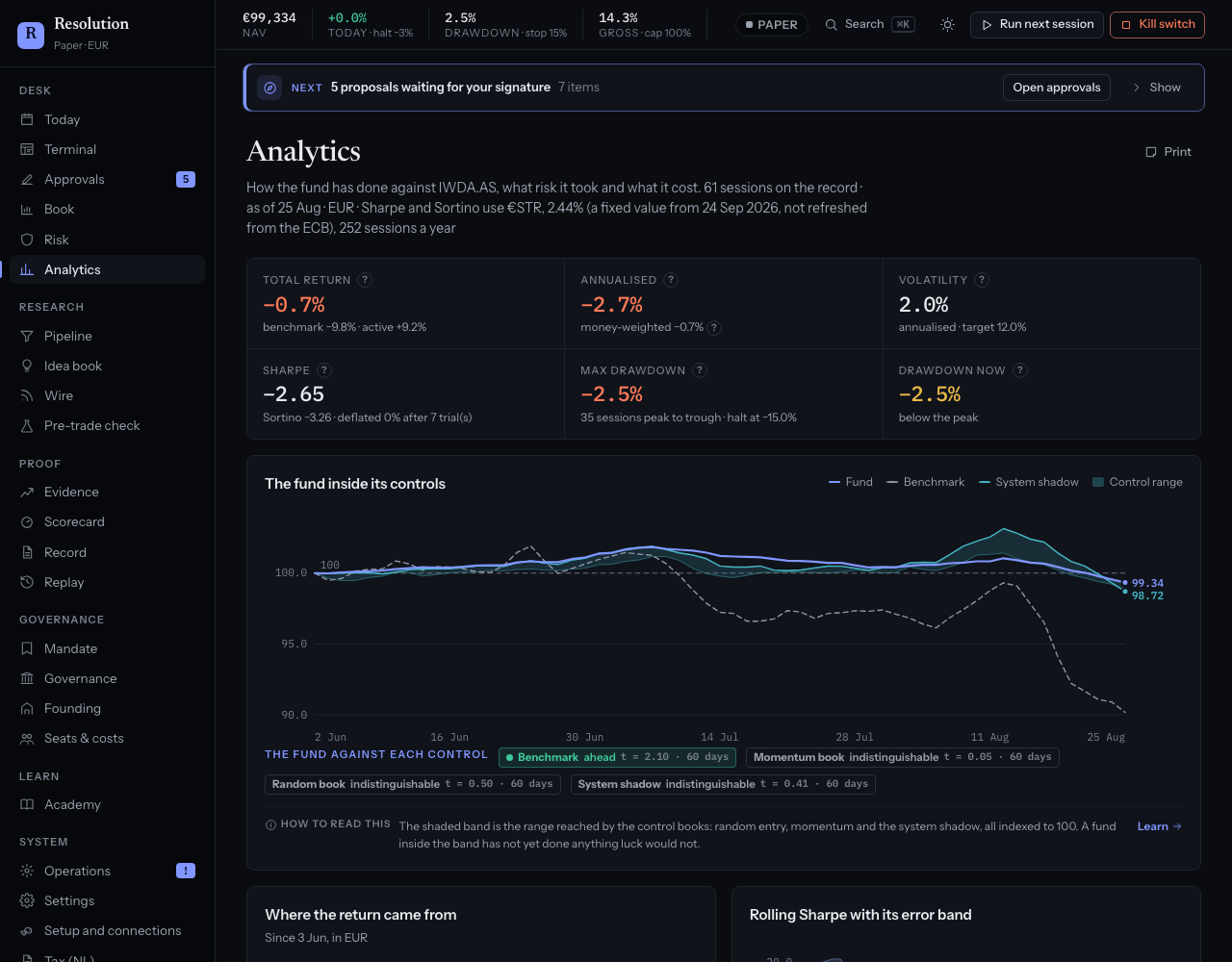
- Time- and money-weighted return, volatility, Sharpe, Sortino, drawdown, VaR and CVaR 95%, Omega, Ulcer index, tail ratio, up/down capture, PSR, beta, factors, attribution, stress and reverse stress tests.
- Look-through shows what an ETF actually holds, and the caps use it.
- Costs split into commission, spread and FX markup; paper trading models IBKR's fixed and tiered fees.
- A figure that cannot be computed yet says why, instead of showing a number.
A Terminal for research
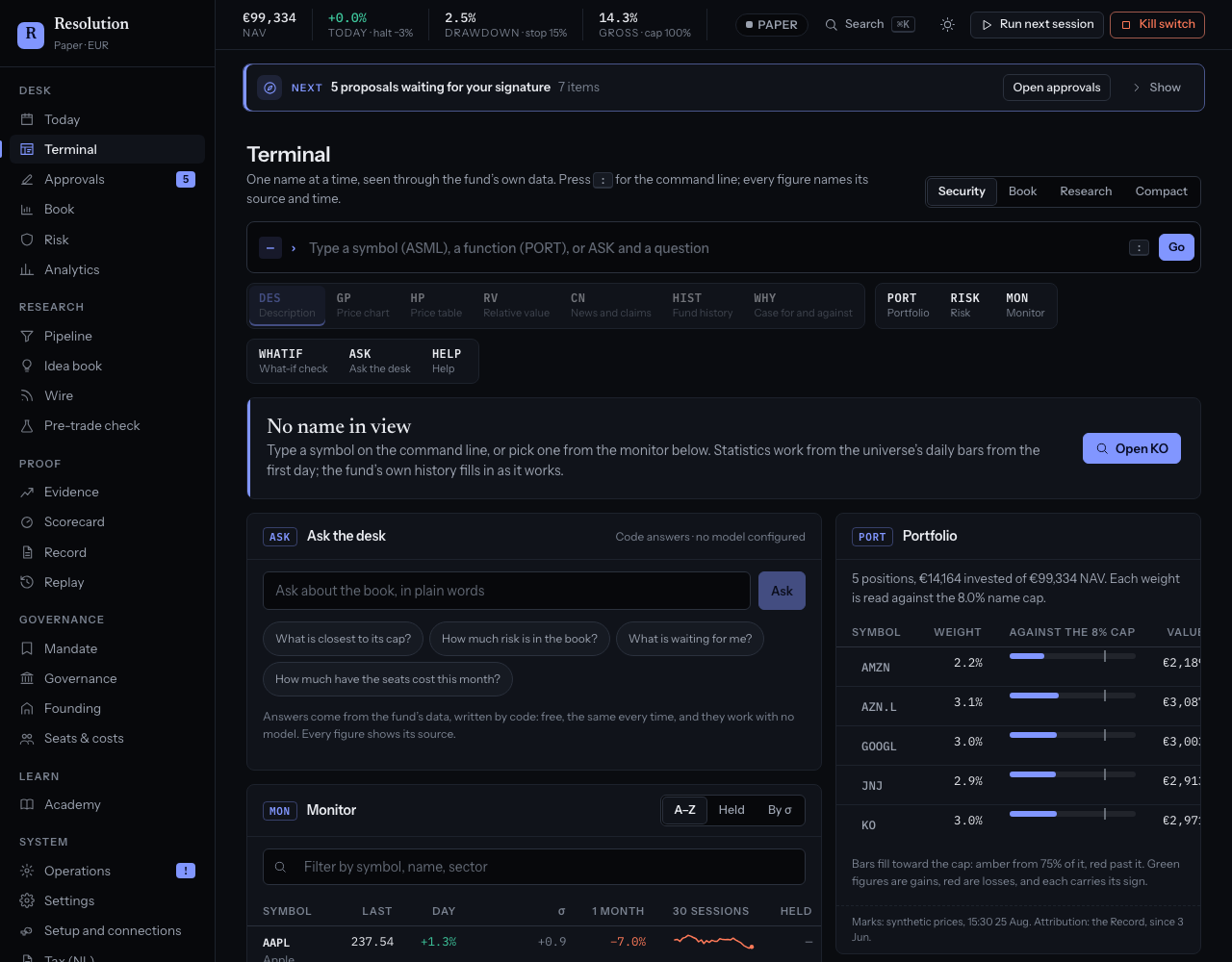
- Keyboard first: function mnemonics, linked panels and a desk you can ask in plain language, in English or Dutch.
- No order ticket. A what-if goes to the same kernel check an order would face.
⌘Kopens a palette with every screen and action;gthen a letter goes to a screen.
An Academy that uses your own fund
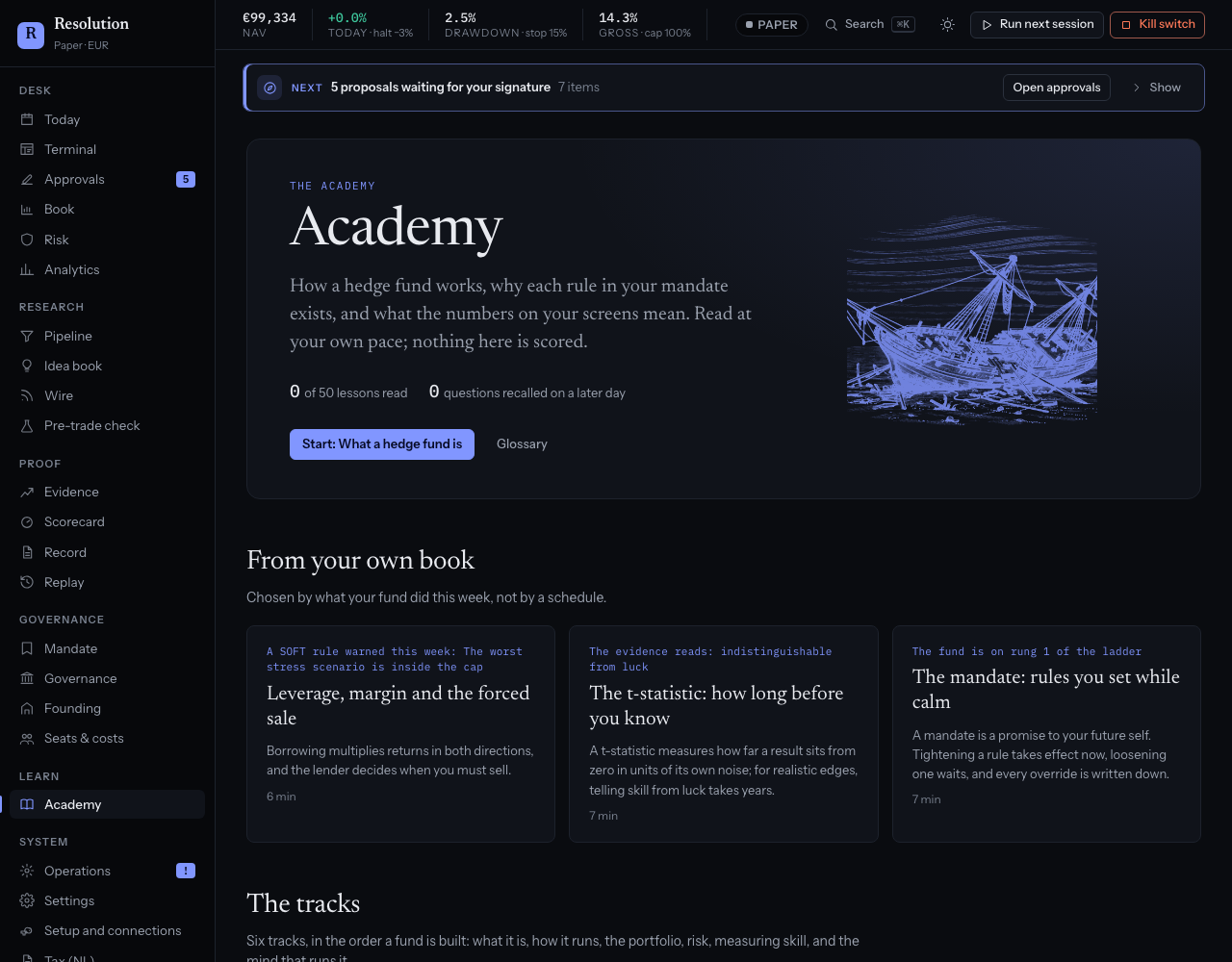
- 50 lessons, 12 cases and 209 glossary terms in English and Dutch, with simulators and panels that read your book.
- Chosen by what your fund did this week. When a rule bites, its lesson is one click from the ticket.
- Recall is spaced. No streaks, no points, no badges.
Made for a Dutch or EU owner
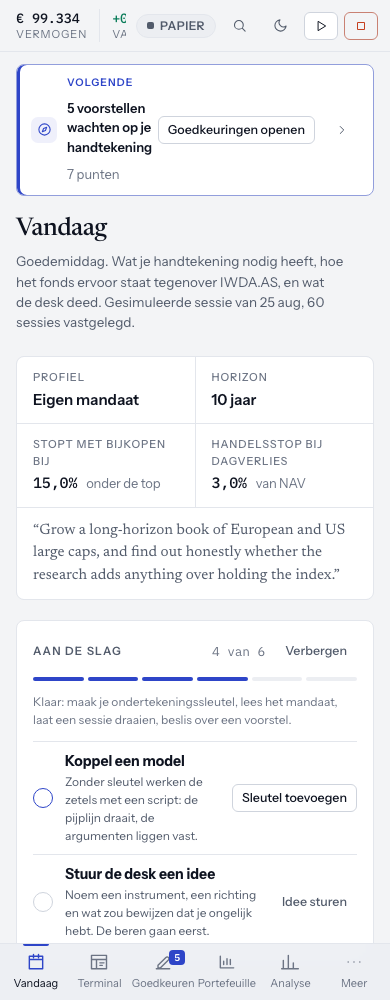
- The whole desk in Dutch; numbers and dates follow the language (
€ 1.234,56,25 sep 2026). - Box 3 on 1 January worked step by step with cited parameters, and the actual-return evidence (tegenbewijsregeling). Information, not tax advice.
- Dividend tax withheld abroad compared with treaty rates, per country.
- CSV imports from DEGIRO, IBKR, Trading 212, XTB, Revolut and Rabobank, with a dry-run preview; IBKR Flex Query pulls.
- EU exchange calendars, €STR, KID checks, GDPR export and erase, and a note on the regulatory position.
Connects to everything
- A public
/api/v1with OpenAPI 3.1 and scoped tokens. Other software can read, and send an idea, nothing more. - Signed webhooks with the Standard Webhooks headers, an MCP server for assistants (OAuth 2.1 with PKCE), Atom feeds, Prometheus metrics, a Beancount export for Fava.
- Nine notification channels, with quiet hours; HARD notices always go out, SOFT notices wait for the morning digest.
- One Connections page tests each system and names the fix.
A Record you can prove
- Every event is hash-chained and append-only, on PostgreSQL or the built-in store.
- Verify the chain, anchor signed checkpoints off the machine, optionally with OpenTimestamps, and replay the fund as it stood after any event.
- Scheduled encrypted backups with an off-machine copy, a weekly restore drill and a dead-man's switch.
- A kill switch from the screen or the shell that cancels open orders and halts trading.
Security, in one line each
- No broker password, ever. You log in to the broker's own gateway.
- Every order is signed in your browser with a key the server never sees; a passkey guards approvals and going live once one is enrolled.
- Secrets never enter the Record, the logs, a prompt or the browser.
- The server listens on loopback; every write needs a header a cross-site form cannot add; nothing loads from a third party.
- The desk opens offline with the age of its figures; checks, approvals and signatures never come from a cache.